
How Sleep Destroys (or Saves) Your Weight Loss Efforts
Sleep and weight loss are connected in ways you'd never expect. Research shows poor sleep can reduce fat loss by 55%. Learn the science-backed strategies here.
Loraine Berriman
11/10/202511 min read
Here's something most people don't realize: you can follow your diet perfectly, hit the gym consistently, and still sabotage your weight loss without knowing it. The culprit? Your sleep habits.
The Science-Backed Connection Between Sleep and Weight Loss
Sleep and weight loss are more interconnected than most people realize. When you consistently sleep fewer than 7 hours per night, your body undergoes hormonal changes that actively work against fat loss. Research from the University of Chicago found that sleep-deprived dieters lost 55% less body fat compared to well-rested dieters, even when eating the same calories. This isn't about willpower or motivation. It's about biochemistry.
Why Your Sleep Schedule Could Be Sabotaging Everything
I've worked with dozens of clients who couldn't understand why their weight loss plateaued despite perfect nutrition and training. The common denominator? They were averaging 5-6 hours of sleep per night.
One client, Sarah, came to me frustrated after three months of strict dieting with minimal results. Her food logs were impeccable. Her workouts were consistent. But she was barely sleeping because of work stress and late-night Netflix binges.
Within four weeks of prioritizing 7-8 hours of quality sleep and our science-backed training and nutrition strategies, she broke through her plateau and lost 3 kilograms, most of it from her midsection. The data backs this up: a 2012 study showed that better sleep quality increased the likelihood of successful weight loss by 33%.
Here's what happens when you don't get enough sleep: your body essentially enters a metabolic crisis mode. It starts hoarding fat and burning muscle instead. Not exactly what you signed up for when you started your weight loss journey.
The Hormonal Hijacking That Happens While You're Awake
Your body regulates appetite through two primary hormones: leptin and ghrelin. Think of leptin as your "I'm full" signal and ghrelin as your "I need food now" alarm.
When you're well-rested, these hormones work in harmony. You feel satisfied after meals. You're not constantly thinking about food. Your metabolism hums along efficiently.
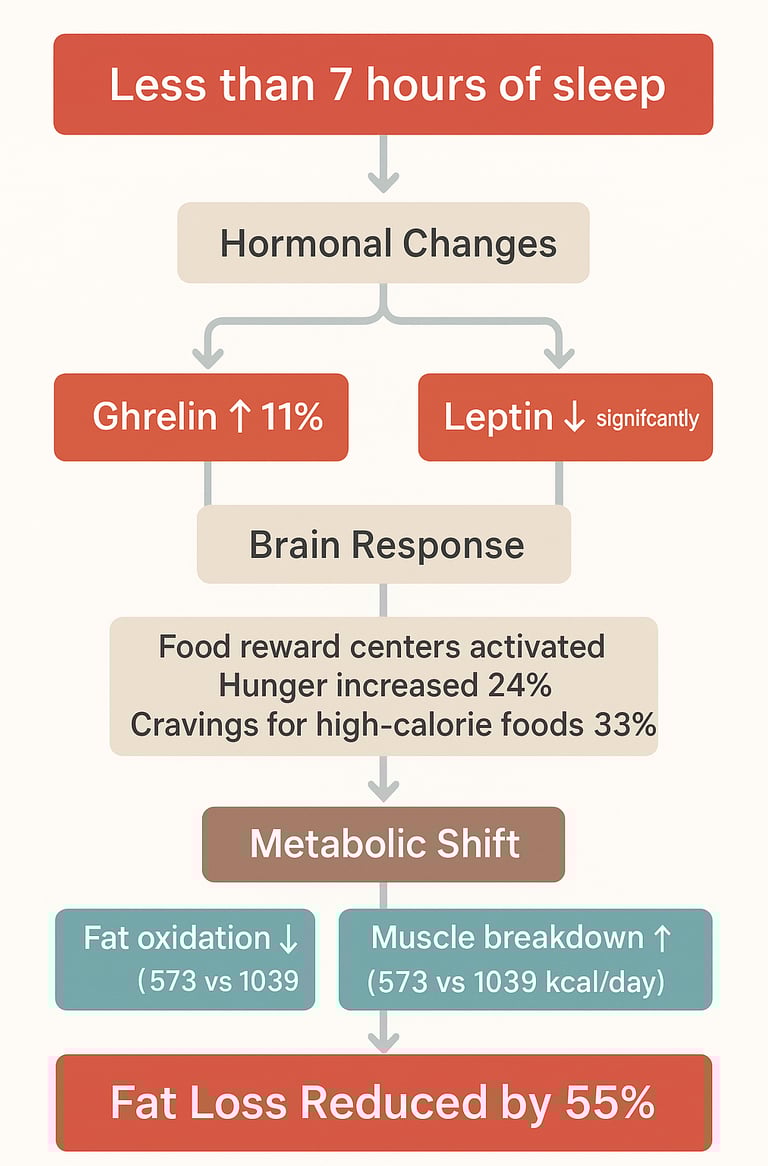
But here's where it gets interesting. Sleep restriction leads to a 24% increase in hunger ratings, with a 33% increase in consumption of calorie-dense and carbohydrate-rich foods. That's not a small difference. That's the difference between staying on track and demolishing a family-size bag of chips at 10 PM.
What Actually Changes in Your Body
After just one night of total sleep deprivation, research from 2023 found that leptin levels decreased while ghrelin and adiponectin levels increased significantly. Translation? You're hungrier, your body is less likely to burn fat, and you're more prone to storing calories.
The numbers are stark. In controlled studies, sleep-deprived individuals showed:
11% higher ghrelin levels after just one night of poor sleep
Lower leptin concentrations, indicating reduced satiety signaling
Increased activation of brain regions sensitive to food stimuli
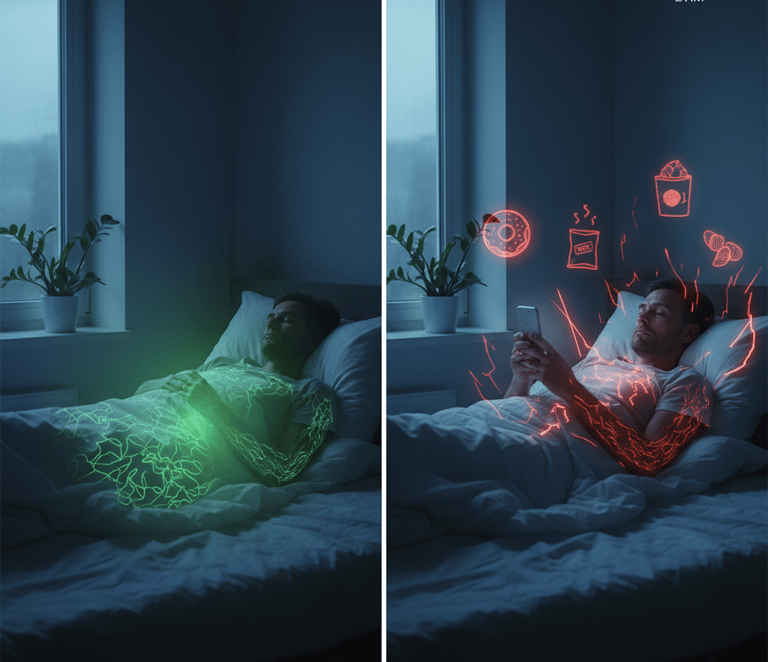
Your brain literally becomes more responsive to food cues when you're tired. Ever notice how everything looks delicious at 2 AM after a late night? That's not random. Your neural pathways are screaming for quick energy because your body thinks it's in survival mode.
The Devastating 55% Fat Loss Reduction
Let's talk about the research that should make every dieter rethink their sleep schedule.
In a landmark 2010 study published in Annals of Internal Medicine, researchers found that sleep curtailment decreased the fraction of weight lost as fat by 55%. Same calorie deficit. Same participants. Different sleep schedules. Dramatically different body composition results.
Here's what happened:
8.5 hours of sleep group: Lost 1.4 kilograms of fat and 1.7 kilograms of lean mass
5.5 hours of sleep group: Lost only 0.6 kilograms of fat but 2.4 kilograms of lean mass
Both groups lost about 3kg total. But the sleep-deprived group was burning through muscle while preserving fat, exactly the opposite of what you want.
Why Your Body Chooses Muscle Over Fat
When you're sleep-deprived, your body shifts into a conservation mode that scientists call "enhanced neuroendocrine adaptation to caloric restriction." Essentially, your body gets really good at holding onto stored energy (fat) while sacrificing metabolically active tissue (muscle).
This happens because your resting respiratory quotient changes. Studies show that adequate sleep leads to a shift toward greater fat oxidation at rest, while sleep restriction prevents this metabolic advantage.
Your body becomes less efficient at using fat for fuel. It starts breaking down protein from your muscles instead. Over weeks and months, this completely derails your body composition goals.
The Sleep-Weight Loss Method That Actually Works
After reviewing hundreds of studies and working with clients for over a decade, I've developed a systematic approach to leveraging sleep for optimal fat loss.
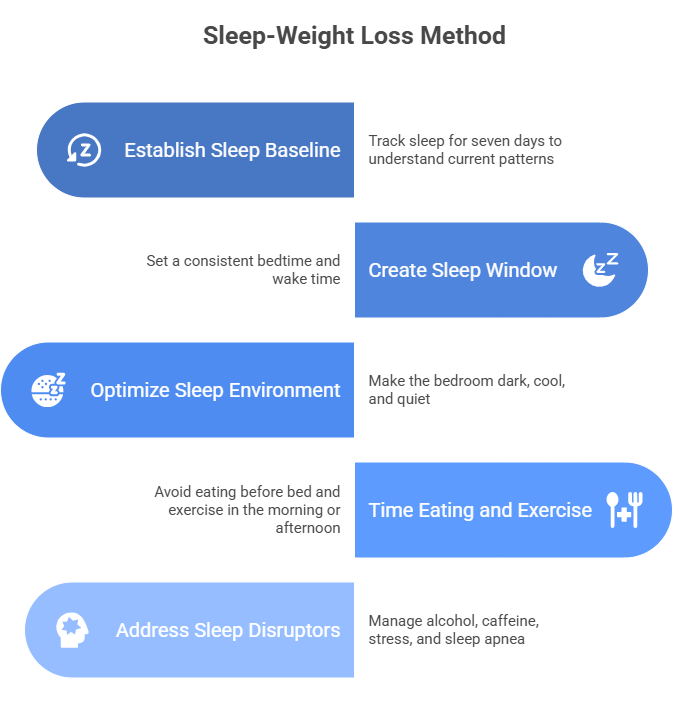
Step 1: Establish Your Sleep Baseline (Week 1)
Don't guess about your sleep. Track it for seven days without changing anything.
Use a simple journal or app to record:
Time you got in bed
Estimated time you fell asleep
Wake-up time
How you felt in the morning (1-10 scale)
Any nighttime wake-ups
Most people discover they're getting 60-90 minutes less sleep than they thought. That gap matters.
Step 2: Create a Non-Negotiable Sleep Window (Week 2-3)
Pick a bedtime and wake time that allows for 8 hours in bed (aiming for 7+ hours of actual sleep). Then treat it like an important meeting you can't miss.
I tell clients to work backward from their wake time. If you need to be up at 6 AM, your head needs to hit the pillow by 10 PM. That means starting your wind-down routine by 9 PM.
Step 3: Optimize Your Sleep Environment
Your bedroom should be a cave: dark, cool, and quiet.
Practical changes that make a difference:
Install blackout curtains or use a sleep mask
Keep the room between 18-19°C (your body temperature needs to drop for deep sleep)
Remove all screens 60 minutes before bed
Use white noise or earplugs if you have a noisy environment
One client called these "non-sexy but essential" changes. He was right. They're boring to implement but powerful in effect.
Step 4: Time Your Eating and Exercise
Eating right before bed may reduce the success of weight loss attempts. Cut off food intake 2-3 hours before sleep.
Exercise helps, but timing matters. Morning or afternoon workouts are ideal. Engaging in at least 150 minutes of moderate-intensity or 75 minutes of high-intensity exercise per week can improve sleep quality. But intense evening workouts can actually disrupt sleep for some people. This is why we emphasize strength training programs designed for body composition over endless cardio in our coaching.
Find what works for your schedule and body. The key is consistency, not perfection.
Step 5: Address the Hidden Sleep Disruptors
These are the sneaky factors that steal quality sleep:
Alcohol: Yes, it makes you drowsy, but it fragments your sleep architecture and reduces REM sleep. You'll wake up feeling unrested even after 8 hours.
Caffeine after 2 PM: It has a 5-6 hour half-life. That afternoon coffee is still affecting your brain chemistry at bedtime.
Stress and anxiety: The biggest sleep killer for adults over 30. If your mind races at night, you need a stress management practice (meditation, journaling, therapy) as much as you need a workout routine.
Sleep apnea: If you snore loudly or wake up gasping, get evaluated. Untreated sleep apnea makes fat loss nearly impossible while increasing serious health risks.
The Costly Mistake Most Dieters Make
They prioritize everything except sleep.
They'll meal prep for hours on Sunday. They'll wake up at 5 AM for the gym. They'll track every calorie down to the gram. But they'll still stay up scrolling social media until midnight or binge-watching shows until 1 AM.
Here's the reality: adults with obesity and short sleep duration or poor sleep quality regained weight during weight loss maintenance phases in a 2023 study, while those with normal sleep duration maintained their losses.
You can lose weight with poor sleep, but you probably can't keep it off. The research is clear on this.
The mistake compounds over time. Each night of poor sleep makes the next day harder. You're more tired, so you move less. You're hungrier, so you eat more. Your willpower is depleted, so you make worse choices. The weight creeps back on, and you blame yourself for lacking discipline.
But it wasn't discipline you needed. It was sleep. Real success requires a comprehensive approach to fat loss that addresses sleep, stress, nutrition, and movement.
How Sleep Compares to Other Weight Loss Factors
Let's put sleep in context with other weight loss interventions:
Calorie Deficit: Essential foundation. You can't lose weight without it.
Effectiveness: 10/10
Sustainability: 5/10 (most people struggle long-term)
Impact on body composition: Depends entirely on other factors
Strength Training: Builds muscle, increases metabolism, improves body composition.
Effectiveness: 8/10
Sustainability: 7/10 (requires consistent effort)
Impact on body composition: Excellent when combined with adequate protein and sleep
Cardio Exercise: Burns calories, improves cardiovascular health.
Effectiveness: 6/10 (easy to compensate by eating more)
Sustainability: 6/10 (many people find it boring)
Impact on body composition: Moderate (can lead to muscle loss if overdone)
Adequate Sleep (7-9 hours): Optimizes hormones, increases fat oxidation, preserves muscle.
Effectiveness: 9/10 (force multiplier for all other interventions)
Sustainability: 8/10 (once habits are established)
Impact on body composition: Excellent (specifically promotes fat loss over muscle loss)
The difference? Sleep makes everything else work better. It's the foundation that supports your entire weight loss effort.
A well-rested person will stick to their diet more easily, recover from workouts faster, and maintain their weight loss long-term. A sleep-deprived person is fighting an uphill battle with their own biochemistry.
The Counter-Intuitive Truth About Sleep and Weight Loss
Here's what surprised me after years of working with clients: more sleep doesn't mean less activity or fewer calories burned.
Most people assume sleeping more means they'll be sedentary. The opposite is true.
When you're well-rested, you naturally move more throughout the day. You take the stairs instead of the elevator. You're more likely to go for that evening walk. You have the energy to play with your kids instead of collapsing on the couch.
This phenomenon is called NEAT (Non-Exercise Activity Thermogenesis), and it can account for 300-500 calories per day variation between well-rested and sleep-deprived individuals.
There's also this: in one study, total energy loss was twice as high in the 8.5-hour sleep group (1039 kcal/d) compared to the 5.5-hour sleep group (573 kcal/d), despite eating the same calories.
Your body literally burns more total energy when you're well-rested. Not because you're exercising more, but because your metabolism functions more efficiently.
The biggest mind-shift? Stop viewing sleep as "doing nothing" or "being lazy." Sleep is when your body repairs muscle tissue, balances hormones, consolidates memories, and yes, burns fat. It's not downtime. It's prime time for weight loss.
This Is What Matters
Your body doesn't work like it did at 20. You can't party until 2 AM, sleep for 4 hours, and still crush your goals the next day.
The research is unambiguous: if weight loss is your goal, sleep is non-negotiable.
A 2025 study found that individuals with sleep disturbances had significantly higher BMI, waist circumference, and body fat percentage. The relationship isn't subtle. It's direct and measurable.
Here's your action plan starting tonight:
Calculate your ideal bedtime (wake time minus 8 hours)
Set a phone alarm for your wind-down routine (60 minutes before bed)
Make your bedroom actually dark (test: can you see your hand in front of your face?)
Commit to 7 nights of prioritizing sleep over everything else
Track your hunger, energy, and weight for those 7 days. I'm confident you'll see a difference.
Are you ready to finally make sleep work for your weight loss? Our personal training programs at The Fitness Edit incorporate comprehensive lifestyle coaching, including sleep optimization strategies tailored to your schedule and goals. Book a free consultation or explore our options to learn how we can help you achieve sustainable fat loss through science-backed training, nutrition, and recovery protocols.
FAQs:
Q: How does sleep affect weight loss?
A: Sleep directly impacts weight loss through hormonal regulation and metabolic function. When you sleep fewer than 7 hours per night, your body produces more ghrelin (hunger hormone) and less leptin (satiety hormone), making you significantly hungrier. Research shows sleep-restricted dieters lose 55% less body fat compared to well-rested dieters, even when eating identical calories. Additionally, poor sleep shifts your metabolism toward burning muscle instead of fat, compromising your body composition goals.
Q: How many hours of sleep do I need to lose weight effectively?
A: Most adults need 7-9 hours of quality sleep per night for optimal weight loss. The sweet spot for most people is 7.5-8 hours. Studies consistently show that sleeping less than 7 hours per night is associated with reduced fat loss, increased hunger, and greater likelihood of weight regain. One study found that sleeping more than 7 hours per night increased the likelihood of successful weight loss by 33%. Quality matters too: interrupted or poor-quality sleep can be as detrimental as short sleep duration.
Q: Can lack of sleep cause weight gain even if I eat healthy?
A: Yes, absolutely. Sleep deprivation triggers metabolic and hormonal changes that promote weight gain independent of diet quality. Studies involving thousands of participants found that people averaging 6 hours of sleep were 27% more likely to be overweight, while those averaging 5 hours were 73% more likely to be overweight compared to those sleeping 7-9 hours. Poor sleep increases appetite, reduces impulse control around food, decreases physical activity through fatigue, and fundamentally alters how your body processes calories, shifting toward fat storage rather than fat burning.
Q: Sleep restriction vs sleep deprivation: what's worse for weight loss?
A: Both negatively impact weight loss, but chronic sleep restriction (consistently getting 5-6 hours) may be more damaging long-term than occasional sleep deprivation. Sleep restriction is insidious because you adapt to feeling tired, not realizing how much it's affecting your hormones and metabolism. Studies show that even moderate sleep restriction (1-2 hours less per night) maintained over weeks leads to increased body fat percentage, reduced fat oxidation, and metabolic changes that persist even with "catch-up" sleep on weekends. Total sleep deprivation (pulling an all-nighter) causes acute hormonal disruption but is usually temporary.
Q: How long does it take to see weight loss results after improving sleep?
A: You may notice appetite changes within 2-3 days of better sleep, with measurable weight loss differences appearing within 2-4 weeks. However, the most significant impact is on body composition over 8-12 weeks. In studies, participants who improved their sleep saw not just more weight loss, but specifically more fat loss and muscle preservation. One client I worked with broke through a 3-month plateau within 4 weeks of increasing her sleep from 5.5 to 7.5 hours nightly. Expect the first week to be an adjustment, the second week to feel noticeably better, and weeks 3-4 to show measurable changes on the scale.
Q: Quality sleep vs quantity sleep: which matters more for weight loss?
A: Both are essential, but you need sufficient quantity before quality can truly optimize your results. Research indicates that both total sleep time and sleep quality independently predict fat loss success. You can't compensate for 5 hours of "perfect" sleep any more than you can benefit from 9 hours of fragmented, poor-quality sleep. The goal is 7-9 hours of mostly uninterrupted sleep in a properly dark, cool environment. Studies show that even with adequate duration, sleep disturbances (waking frequently, sleep apnea, insomnia) correlate with higher BMI and reduced weight loss success.
Further reading on The Fitness Edit: 'Belly Fat Supplements That Work.'
You can also read about 'Science-Backed Ways to Break Through Fast.'
Kickstart your fitness journey with our free 5-day 'unstuck' challenge. Stop the guesswork, boost your energy, and build healthy habits that fit your busy life.
References
Clinical Obesity Journal (2024) - Sleep and Weight Loss Scoping Review - Comprehensive review of 35 studies examining the bidirectional relationship between sleep quality, quantity, and weight loss in adults
Annals of Internal Medicine (2010) - Sleep Curtailment and Fat Loss - Landmark study demonstrating 55% reduction in fat loss with sleep restriction during caloric deficit
Obesity Journal (2023) - Acute Sleep Loss Effects on Hormones - Laboratory study showing leptin, ghrelin, and adiponectin changes after one night of sleep deprivation
SLEEP Journal (2023) - Sleep and Weight Loss Maintenance - Research showing short sleep duration predicts poor weight maintenance after initial loss
Frontiers in Nutrition (2025) - Sleep Behaviors and Adiposity - Recent cross-sectional study of U.S. adults linking sleep disturbances to higher BMI and body fat percentage
The information provided in this blog post is intended solely for informational purposes. It is not meant to replace professional medical advice, diagnosis, or treatment. Consult health care providers for personalised medical advice and treatment options related to specific health concerns.
About The Author
Loraine is an International Personal Trainer certified through Trifocus Fitness Academy (South Africa). She believes fitness should be accessible to everyone, regardless of age or starting point, and focuses on creating programs that fit real lives, not the other way around.
© 2025 Elevate Wellness Co. Pty Ltd. All rights reserved


Local Mobile Coaching