
Running vs Walking for Weight Loss | Which Is Better for You?
Trying to lose weight and not sure if you should run or walk? Compare calorie burn, injury risk, heart health, and real-life routines. Get a simple plan from The Fitness Edit to use both for steady fat loss.
Loraine Berriman
9/10/20256 min read


If your goal is weight loss, chances are you have asked yourself whether you should run or walk. Both are proven ways to lose weight and improve health. The best choice usually comes down to your starting fitness, your joints, and what you can stick to on busy days. Here is a friendly deep dive that keeps the science simple and the advice practical, with ideas you can use this week.
Calorie burn: speed versus staying power
Running usually burns more calories per minute than walking because it is higher-intensity and recruits more muscle power with each step. That means if you only have twenty minutes, a run can create a bigger calorie gap in less time. Walking wins on staying power. It is easier to sustain for longer without feeling shattered afterward, which can lead to more total movement across the week. Many clients at The Fitness Edit find that a mix works best. Run when you are short on time. Walk to pad your daily steps and support recovery.
Non-exercise activity, the movement you do outside of workouts, often contributes more to your weekly burn than formal training. Housework, walking the dog, taking the stairs, and standing while on calls all count. Think of your workout as the spark and your daily steps as the steady flame.
Fat loss is about the whole picture
Whether you run or walk, fat loss still depends on a gentle calorie deficit over time, enough protein to keep you full, and some resistance training to maintain lean muscle. A simple approach is to combine two or three strength sessions per week with a daily step target and one or two cardio workouts at the pace that suits you. Strength training may not burn as many calories as a run in the moment, but it helps protect muscle as the scale goes down, which supports shape and long-term metabolism.
Injury risk and joint comfort
Walking is low-impact and very forgiving for knees, hips, and lower back. If you are returning to fitness, have a high BMI, or have a history of niggles, begin with brisk walking and gradually increase pace or incline. Running places more load on the body with each stride. That load is a useful training stimulus when progressed slowly, but it can irritate tissues if you jump the volume too quickly. The 10 percent rule is a good guide for new runners. Increase weekly time or distance by no more than ten percent and rotate easy and harder days.
Your running shoes matter less than your weekly consistency. Studies suggest there is no universal “best” shoe. Comfort and fit are king. If it feels good and you enjoy running in it, you are more likely to keep going.
Heart health and fitness gains
Both walking and running improve cardiovascular health. Running, because it is higher intensity, tends to move you into higher heart rate zones and can boost fitness faster for the same time invested. Brisk walking still provides meaningful benefits, particularly if you push hills, add intervals, or increase pace so that conversation becomes slightly breathy. If you wear a watch, look for sessions where your heart rate climbs into moderate intensity for at least 20 minutes. If you do not track, use the talk test. You should be able to speak in short sentences, but not sing.
Appetite and energy
Hard runs can spike appetite for some people. That is not a bad thing, just something to plan for so you do not overshoot your calorie target afterward. A protein-rich meal or snack post-run often helps. Many walkers report steadier hunger and energy through the day, which can support adherence to a modest calorie deficit. Pay attention to your pattern and choose the option that fits your appetite curve.
Time, convenience, and enjoyment
The best plan is the one you can repeat when life gets busy. If you dread running, you will find reasons to skip it. If you love the feeling of cruising around your neighborhood at sunrise, running will feel easy to schedule. Walking pairs well with calls, podcasts, or catching up with a friend. Running can be a mental reset and a satisfying challenge. Enjoyment drives consistency, and consistency drives results.
What about intervals and hills?
Intervals work for both. Runners can try one minute easy, one minute steady for 20 to 25 minutes. Walkers can alternate two minutes brisk with one minute easy or add hills or incline on a treadmill. Intervals increase total work without needing a long session, and they keep boredom away.
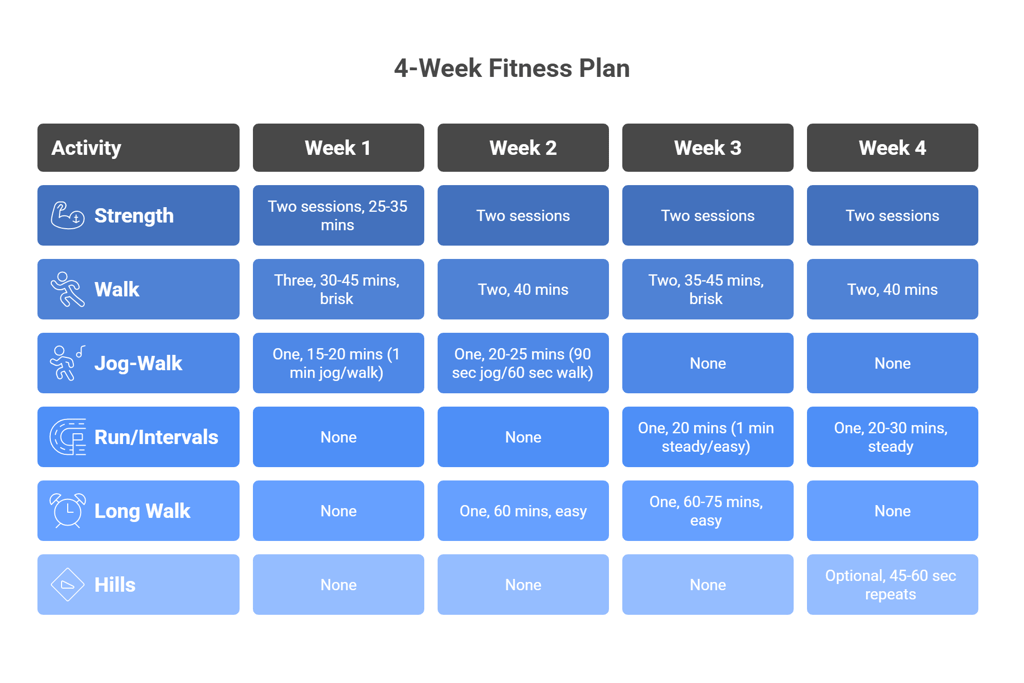
A simple 4-week plan that blends both
You can cut and paste this into your calendar. Adjust days to your schedule.
Week 1
Two strength sessions of 25 to 35 minutes focusing on full body basics.
Three walks of 30 to 45 minutes at a brisk, talkable pace.
Optional: one short jog-walk of 15 to 20 minutes using 1 minute jog, 1 minute walk.
Week 2
Two strength sessions.
Two walks of 40 minutes.
One jog-walk of 20 to 25 minutes using 90 seconds jog, 60 seconds walk.
One long easy walk on the weekend, 60 minutes.
Week 3
Two strength sessions.
One interval run of 20 minutes using 1 minute steady, 1 minute easy.
Two brisk walks of 35 to 45 minutes.
One long easy walk, 60 to 75 minutes.
Week 4
Two strength sessions.
One steady run of 20 to 30 minutes at a conversational effort.
Two walks of 40 minutes.
One optional hills session. Walk or jog up a short hill for 45 to 60 seconds, walk back down, repeat 6 to 8 times.
Keep one day fully off or very light with a gentle mobility session. If joints feel cranky, swap the run for a brisk walk and try again next week.
Nutrition and recovery tips to support your choice
Use the plate method. Half veg and fruit, quarter lean protein, quarter smart carbs, plus a thumb of healthy fats.
Aim for a palm-sized portion of protein at each meal to help with fullness and muscle repair.
Hydrate well, especially in warm summers. Add a pinch of salt to water after hot sessions if you sweat heavily.
Sleep 7 to 9 hours when you can. Good sleep improves appetite regulation and workout quality.
Fun fact: walking after meals improves blood sugar control. Even ten minutes makes a difference, and it doubles as stress relief.


So, which is better for weight loss?
Running is better if you have limited time, enjoy the feeling, and your body tolerates the impact. Walking is better if you value joint friendliness, like longer sessions, or are starting from scratch. The winner for fat loss is the one you will do often, paired with consistent nutrition and simple strength training. Many people see the best results with a walking base, two short runs per week, and steady steps every day.
At The Fitness Edit we build plans around real lives. Some clients travel, others juggle school runs and late meetings. Your program can include run days, walk days, or both, with step goals, short strength workouts, and check-ins that keep you accountable. If you want a coach to map this to your exact week, we are ready to help.
Pick your next move right now. Lace up for a 20-minute brisk walk or a gentle jog-walk loop. Small steps add up faster than you think.
Further reading on The Fitness Edit: 'Navy Seal Fitness Challenge.'
You can also read about 'Cardio vs Weights: Best Strategy for Fat Loss.'
Kickstart your fitness journey with our free 5-day 'unstuck' challenge. Stop the guesswork, boost your energy, and build healthy habits that fit your busy life.
References
Harvard T. H. Chan School of Public Health: Staying Active
The information provided in this blog post is intended solely for informational purposes. It is not meant to replace professional medical advice, diagnosis, or treatment. Consult health care providers for personalised medical advice and treatment options related to specific health concerns.
About The Author
Loraine is an International Personal Trainer certified through Trifocus Fitness Academy (South Africa). She believes fitness should be accessible to everyone, regardless of age or starting point, and focuses on creating programs that fit real lives, not the other way around.
© 2025 Elevate Wellness Co. Pty Ltd. All rights reserved

Local Mobile Coaching